Perplexity and Burstiness, Explained
If you have ever wondered what an AI detector is actually looking at, the answer is mostly two things: how predictable your word choices are, and how much your sentences vary. Those are perplexity and burstiness.
Perplexity: how surprising is the next word?
Perplexity measures how well a language model predicts a piece of text. Low perplexity means the words were largely what the model expected. High perplexity means the text kept surprising it.
Consider: “The cat sat on the ___”. Almost every model predicts “mat”. That is a low-perplexity continuation. If the sentence instead ends “…on the negotiating table”, perplexity spikes — the word was unexpected given everything before it.
Generated text tends toward low perplexity for a structural reason: models are built to produce probable continuations. Even with sampling introducing randomness, the output clusters around what is likely. Human writers reach for the odd word, the personal reference, the slightly wrong-but-better phrase far more often.
Burstiness: how much does the rhythm vary?
Burstiness measures variation in sentence length and complexity across a passage.
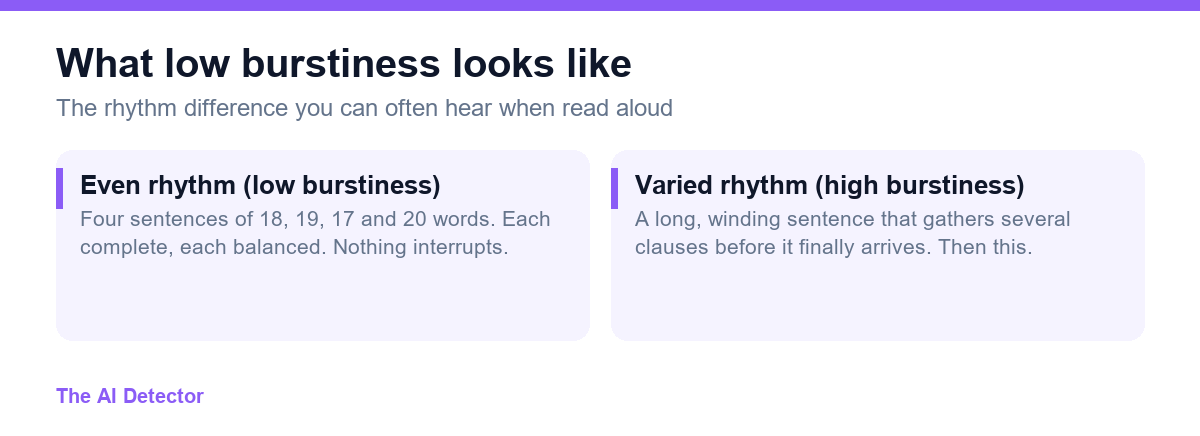
Human writing is bursty. A writer produces a long, clause-heavy sentence that develops an idea across several turns, and then follows it with four words. The rhythm rises and falls, often without the writer noticing.
Generated text tends to be smoother. Sentences cluster around a similar length, each one grammatically complete and similarly weighted. Nothing interrupts.
How the two work together
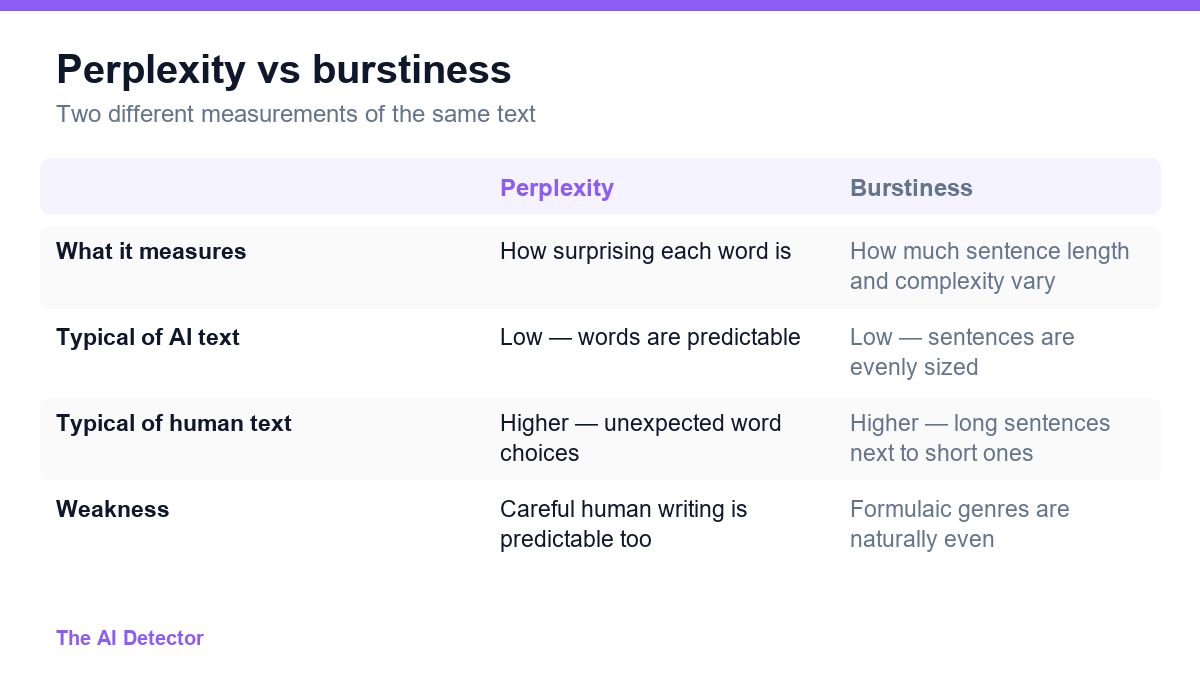
Neither measure is sufficient alone. Careful, formal human writing can score low on perplexity. Some technical genres are naturally low in burstiness. It is the combination — predictable word choice and even rhythm, sustained across a long enough passage — that carries most of the signal.
Modern detectors do not compute these two numbers and stop. They typically use trained classifiers over many features. But perplexity and burstiness remain the intuition underneath, and they explain most of the behaviour you will observe.
Why this explains the false positives
Once you understand the mechanism, the failure modes stop being mysterious.
- Second-language writers often use more common vocabulary and steadier structure — low perplexity, low burstiness, entirely human.
- Formulaic genres — lab reports, legal boilerplate, structured summaries — are low-variety on purpose.
- Heavily edited prose can be smoothed toward the middle by the editing itself.
- Careful academic writing deliberately avoids surprising word choices.
None of these are cheating. They are writing styles that happen to sit near the statistical region where generated text lives.
What raises perplexity and burstiness naturally
Not as a trick — as a description of what strong writing tends to do. Specific details and real numbers instead of generalities. Varied sentence length, including deliberately short ones. Concrete verbs. A position the writer is willing to defend. Examples drawn from actual experience rather than invented illustrations.
These are the same things that make writing better to read, which is not a coincidence.
See it on your own text
Run a passage through our free AI detector and see how the statistics read.
Open the AI Detector →Frequently asked questions
What is perplexity in AI detection?
Perplexity measures how predictable a piece of text is to a language model. Low perplexity means the words were largely expected; high perplexity means the text was surprising. Generated text tends toward lower perplexity because models produce probable continuations.
What is burstiness in writing?
Burstiness measures how much sentence length and complexity vary across a passage. Human writing tends to be bursty, mixing long sentences with very short ones. Generated text is often smoother and more even.
Why does AI writing have low perplexity?
Because language models are built to predict likely continuations. Even with randomness in sampling, output clusters around probable word choices, while human writers more often reach for unexpected ones.
Can human writing have low perplexity and burstiness?
Yes, and this is the main cause of false positives. Second-language writers, formulaic genres such as lab reports, and carefully edited academic prose can all show this profile while being entirely human.
Do detectors only use perplexity and burstiness?
Modern detectors typically use trained classifiers over many features rather than these two numbers alone. But perplexity and burstiness remain the underlying intuition and explain most observed behaviour.
Related: How Accurate Are AI Detectors? · Methodology · AI Detector