How Accurate Are AI Detectors, Really?
Short answer: good detectors are a useful signal on longer, unedited text, and unreliable on everything else. That is a less satisfying answer than a percentage, but it is the honest one — and it is the only way to use these tools without hurting someone.
Why a single accuracy number is misleading
Every detector quotes an accuracy figure, and every figure is true only of the test set it was measured on. Change the conditions and the number moves — often a lot.
Accuracy depends on how long the text is, whether it was edited after generation, which model produced it, what genre it belongs to, and whether the author writes English as a first language. A detector that scores well on 800-word unedited essays from one model may perform far worse on a lightly rewritten 200-word paragraph from another.
So when you see a percentage, the useful question is not “is that high?” but “measured on what?”
The two kinds of error
Detection has two failure modes, and they are not equally serious.
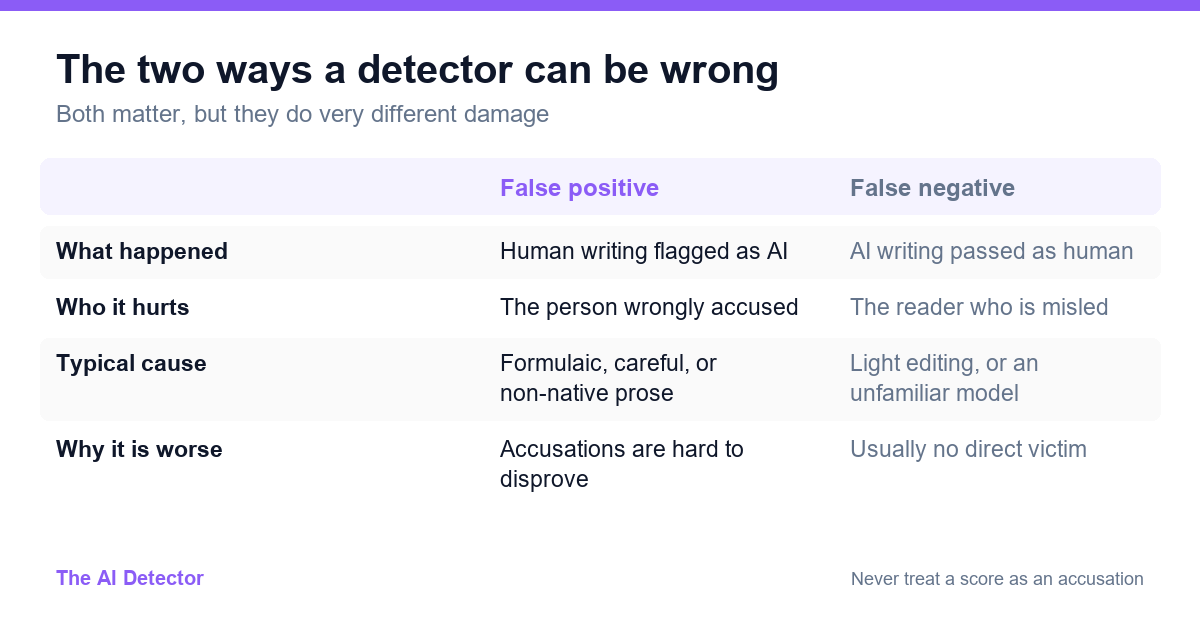
A false negative means AI text passed as human. Usually nobody is directly harmed.
A false positive means a human was told their own writing looks machine-generated. That can mean an academic misconduct process, a failed assignment, or a damaged professional reputation — over a probability estimate. Because it is very hard to prove you wrote something yourself, the burden lands on the accused.
This asymmetry is the single most important thing to understand about detection. It is why no score should ever be treated as an accusation on its own.
Where detectors struggle
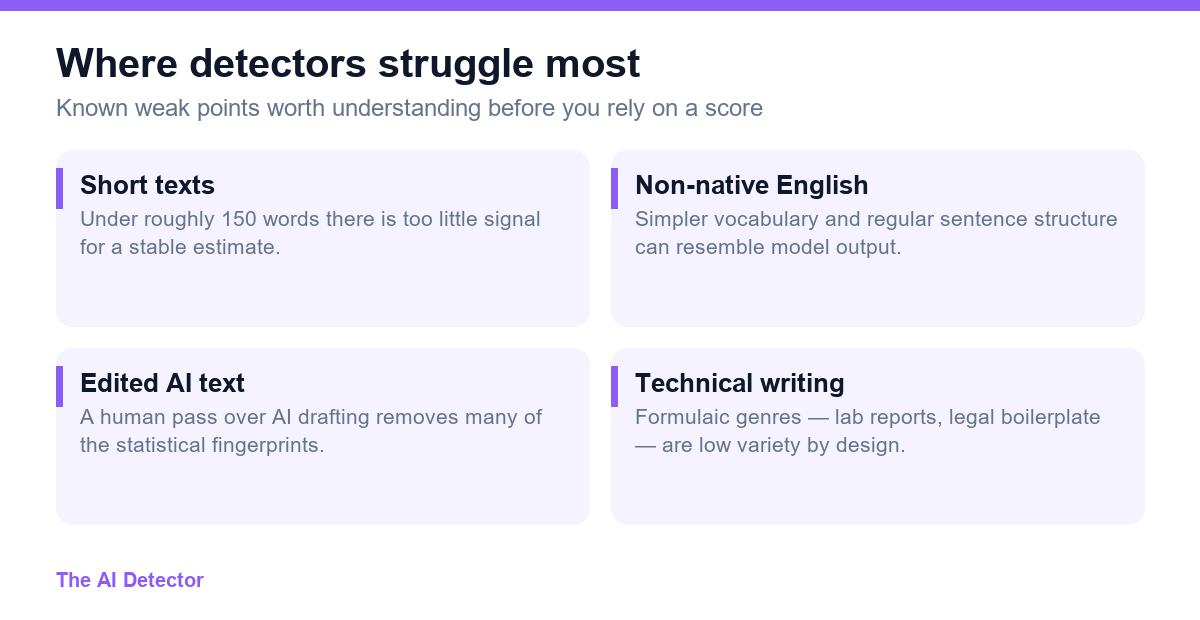
The non-native English case deserves particular emphasis. Writers working in a second language often use a more regular sentence structure and a more common vocabulary — precisely the statistical profile that detectors associate with generated text. Any process that applies detection uniformly risks flagging these writers disproportionately.
How to read a score responsibly
Treat the output as one input among several, and weight it by the conditions above.
- Check the length. Under about 150 words, treat any result as inconclusive.
- Treat the middle as unknown. Scores near the midpoint mean the text has mixed signals, not that it is half AI.
- Never use a score alone to make a decision about a person. Ask about process instead: drafts, notes, version history, or a conversation about the content.
- Re-run on a longer sample if you have one. More text means a more stable estimate.
What detection is genuinely good for
Used properly, it is a triage tool. It is well suited to screening large volumes of content to decide what deserves a closer human look, to checking whether a supplier delivered what they claimed, and to giving writers a sense of whether their own drafting reads as generic.
It is poorly suited to adjudicating individual cases where the consequences are serious. That requires evidence about process, not statistics about prose.
Check a piece of text
Paste your text into our free AI detector for a probability score in seconds. No signup.
Open the AI Detector →How our detector reports results
We return a probability with a plain-language label, and we say when a text is too short to assess. We do not return a binary verdict, because the underlying method does not support one. Our methodology page explains what the model looks at.
Frequently asked questions
How accurate are AI detectors?
On longer, unedited text good detectors are a useful signal. Accuracy drops substantially on short passages, edited AI output, and formulaic or non-native English writing. Any single accuracy percentage only describes the specific test set it was measured on.
Can AI detectors be wrong?
Yes, in both directions. False negatives let AI text pass; false positives flag human writing as AI. False positives are the more damaging error because it is very difficult to prove you wrote something yourself.
Do AI detectors flag non-native English speakers more often?
This is a known concern. Writing in a second language often uses more regular sentence structure and more common vocabulary, which resembles the statistical profile detectors associate with generated text.
Is a high AI score proof someone cheated?
No. A detector estimates how closely text resembles generated writing. It cannot observe how the text was produced. A score should never be the sole basis for an accusation.
How long should text be for reliable detection?
Longer is better. Below roughly 150 words there is generally too little signal for a stable estimate, and results should be treated as inconclusive.
Related: AI Detector · Perplexity and Burstiness Explained · Methodology