How to Make Your Writing Sound More Human
Writing that reads as generic has identifiable causes: even rhythm, abstract nouns, hedged claims, and no specific detail. Fixing those makes writing clearer and more convincing — which is the point. This is a guide to writing better, not to disguising anything.
Why writing reads as generic
Flat prose is usually not a vocabulary problem. It is a commitment problem. Generic writing avoids specifics, avoids arguable positions, and avoids rhythm — because all three require decisions.
The good news is that the fixes are mechanical enough to apply deliberately.
1. Vary your sentence length
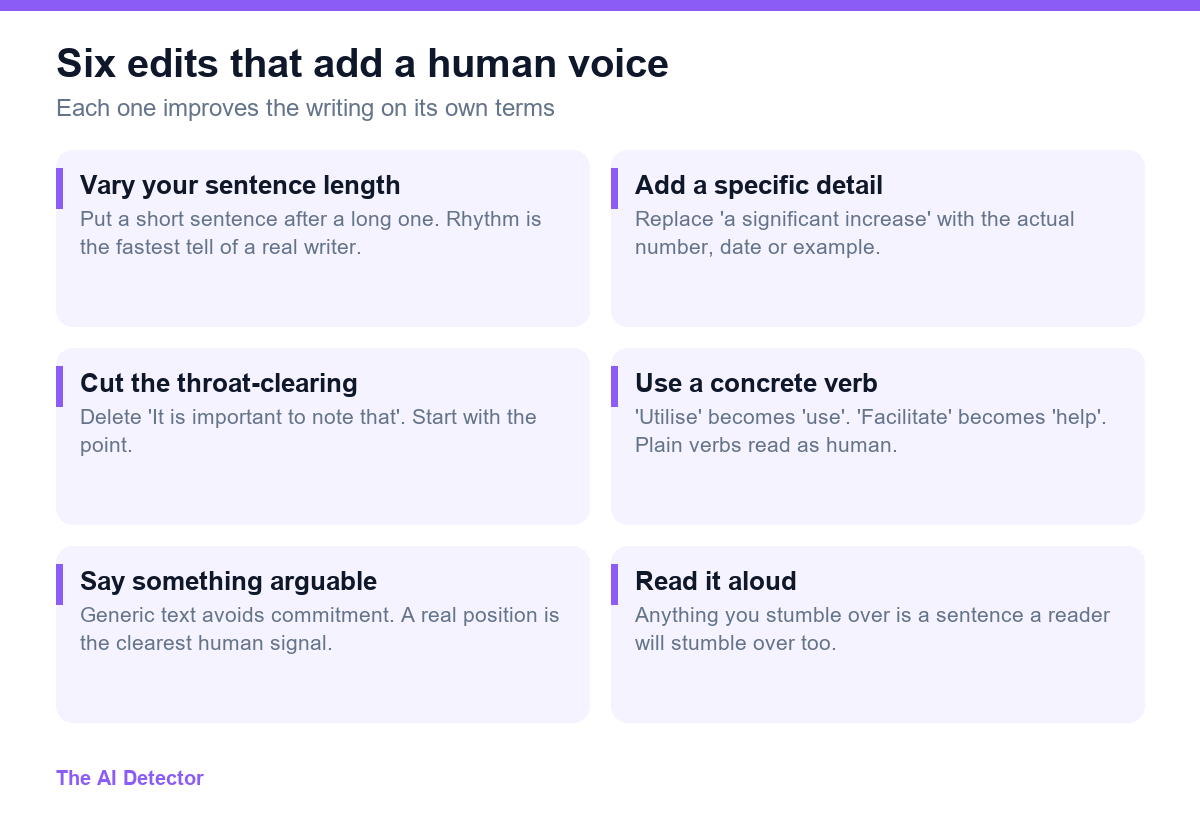
This is the highest-leverage change available, and the easiest to check. Count the words in five consecutive sentences. If they are all between fifteen and twenty-five, the passage will read as flat no matter how good the content is.
The fix: after a long sentence, write a short one. Four words is fine. One word can work.
Rhythm is how readers experience prose, and variation is what keeps attention moving.
2. Add a detail only you would know
Replace “a significant increase in engagement” with “engagement went from 4% to 11% over six weeks”. Replace “many experts believe” with the name of one and what they actually said.
Specificity is the clearest signal of genuine knowledge, because generic text cannot produce it. It is also simply more useful to the reader.
3. Cut the throat-clearing
Phrases that delay the point: It is important to note that, In today's fast-paced world, When it comes to, There are several factors to consider.
Delete them and start with the actual content. Most paragraphs improve immediately, and many first sentences turn out to be disposable entirely.
4. Use concrete verbs
“Utilise” becomes “use”. “Facilitate” becomes “help”. “Leverage” becomes “use” again. “A determination was made” becomes “we decided”.
Abstract, nominalised constructions read as institutional. Plain verbs with a clear subject read as a person talking.
5. Say something arguable
The strongest human signal in any piece of writing is a position someone could disagree with. Generic text hedges everything, because hedging is safe and requires no judgement.
If a paragraph could appear unchanged in a competitor's article, it is not carrying your perspective. Say what you actually think, and say why.
6. Read it aloud
This catches what silent reading misses. Anywhere you stumble, run out of breath, or hear a phrase you would never say to a person, mark it and rewrite it.
It takes a few minutes and it is the most reliable editing pass there is.
What not to do
Some tactics circulate specifically for changing how text scores. They are worth naming because they make writing worse.
- Inserting deliberate errors. Typos do not read as human, they read as careless.
- Swapping in unusual synonyms. Thesaurus substitution produces prose that reads as translated.
- Randomising sentence length without purpose. Rhythm should follow meaning, not a target statistic.
- Adding filler to raise variety. Padding makes writing longer and weaker.
Every one of these degrades the reading experience to move a number. If the writing is worth publishing, make it better instead.
Polish your draft
Our humanizer helps tighten phrasing and improve readability in your own words.
Open the Humanizer →Frequently asked questions
How do I make my writing sound less robotic?
Vary your sentence length so long sentences sit next to short ones, replace generalities with specific numbers and examples, cut opening throat-clearing phrases, use plain verbs, and take a position a reader could disagree with.
Does editing writing to sound human help with AI detectors?
The edits described here improve clarity and voice, which naturally raises the variation detectors measure. But if work is required to be your own, editing it does not make it original — that is a question of authorship, not phrasing.
What makes writing sound generic?
Mostly a lack of commitment: no specific detail, no arguable position, and no variation in sentence rhythm. All three are avoidable with deliberate editing.
Is it acceptable to use AI to help with writing?
That depends entirely on the rules that apply to your context. Many workplaces permit it; many academic settings restrict or prohibit it. Check the policy that governs your work and follow it.
What is the fastest way to improve a draft?
Read it aloud. Anywhere you stumble or run out of breath is a sentence that needs rewriting, and it takes only a few minutes.
Related: Humanizer · Readability Checker · How Accurate Are AI Detectors?